

Reviewed by the SEOPointz team · Last reviewed June 2026. The benchmarks below come from published industry research; your own numbers are the only ones that should drive decisions. SEOPointz may earn a commission from some links; it never changes what we recommend.
Most ecommerce dashboards are built around the next sale. Customer lifetime value (CLV) asks a harder question: across the whole relationship, how much is a customer actually worth — and is that more or less than what you paid to acquire them? Get that number right and it reshapes how you budget ad spend, how aggressively you discount, and which customers you fight to keep. Get it wrong and you can spend yourself into a “growing” business that loses money on every order. This guide shows how to calculate CLV honestly, what a healthy figure looks like, and the levers that actually move it.
What CLV really measures (and the formula that won’t mislead you)
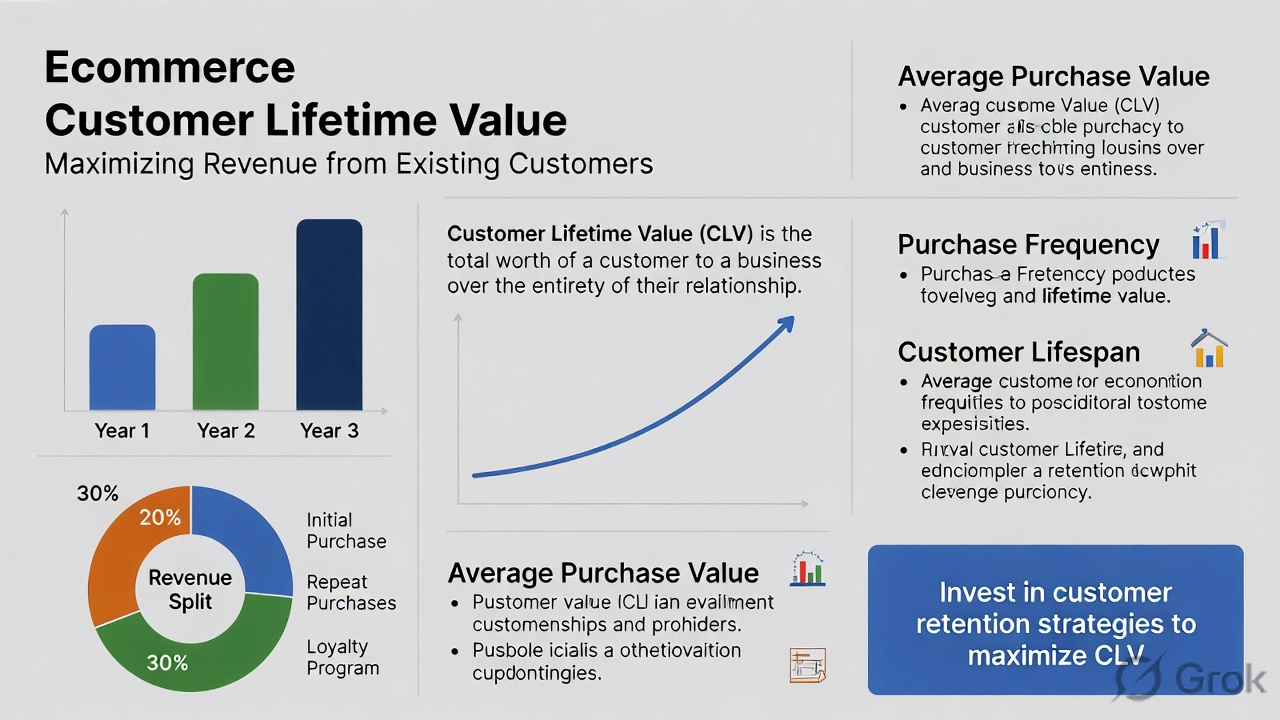
The quick version of CLV multiplies three things: average order value, purchase frequency per year, and the number of years a customer keeps buying. So a customer who spends $60 an order, four times a year, for three years has a revenue CLV of $720. That’s a fine starting point, but it’s revenue, not value — it ignores the cost of the goods. The figure you should actually plan around is margin-based CLV, which multiplies that result by your gross margin. At a 40% margin, the same customer is worth about $288 in real contribution, not $720. Reporting the bigger number to yourself feels good and leads to overspending on acquisition.
For subscription or replenishment models, analysts often use a retention-based variant — gross margin per period multiplied by retention rate divided by (1 + discount rate − retention rate). The math matters less than the discipline behind it: count margin, not revenue, and be conservative about how long customers really stick around.
The one ratio that tells you if you’re winning: CLV to CAC
CLV is only meaningful next to customer acquisition cost (CAC). The widely cited benchmark is a CLV:CAC ratio of roughly 3:1 — for every dollar spent acquiring a customer, you eventually earn about three back in margin. Dip below 2:1 and acquisition is barely paying for itself, or losing money outright once overhead is counted. Climb well above 5:1 and, counterintuitively, you may be under-investing: you could probably afford to bid harder for customers and grow faster. The ratio is a steering wheel, not a trophy.
One caveat worth stating plainly: a flattering CLV:CAC ratio built on a generous CLV estimate is just a way of lying to yourself with extra steps. If your CLV assumes a five-year lifespan but your cohort data shows most customers vanish after two purchases, the ratio is fiction.
Why retention beats acquisition on the math
The reason CLV gets so much attention is that the cheapest revenue you’ll ever earn comes from someone who has already bought from you. The classic research from Bain & Company found that acquiring a new customer can cost several times more than keeping an existing one, and that a 5% lift in retention can increase profits substantially — their oft-quoted range is 25% to 95%, depending on the business. You don’t need to take the exact percentages as gospel to act on the direction: an existing buyer already trusts you, already has an account, and costs almost nothing in media spend to reach again.
Practically, this means the post-purchase experience — shipping updates, a smooth returns process, a well-timed replenishment reminder — is not “customer service overhead.” It’s some of the highest-ROI marketing you have.
Five levers that actually raise CLV
CLV has only three inputs, so every improvement comes down to one of them: spend more per order, buy more often, or stay longer. The tactics that move them:
- Raise average order value with honest cross-sells, bundles, and free-shipping thresholds set just above your current AOV.
- Increase frequency through replenishment reminders, restock alerts, and subscribe-and-save options for consumable products.
- Extend lifespan with a genuinely useful loyalty program and proactive outreach to customers who are going quiet.
- Improve gross margin — even a small margin gain flows straight through to CLV without needing a single new customer.
- Segment and personalize so your highest-value customers get attention proportional to their worth, instead of the same blast everyone else receives.
How to track CLV without overcomplicating it
You do not need a data-science team to start. Most ecommerce platforms and analytics tools can show repeat-purchase rate, average order value, and time between orders — the raw ingredients of CLV. Begin with a simple cohort view: take everyone who first bought in a given month, and watch what they spend over the following 6 and 12 months. That single chart will tell you more than any single CLV number, because it shows whether newer cohorts are getting more or less valuable over time. If each new cohort is worth less than the last, no amount of acquisition spend will fix the underlying problem.
Frequently asked questions
What’s a “good” CLV for an ecommerce store?
There’s no universal target — a luxury goods brand and a $15 phone-case shop live in different worlds. The number that matters is CLV relative to your acquisition cost, with roughly 3:1 in margin terms being a common healthy benchmark. Chase the ratio, not an absolute dollar figure copied from someone else’s business.
Should I use revenue or profit when calculating CLV?
Profit (margin-based). Revenue CLV consistently overstates what a customer is worth and tempts you into overpaying for acquisition. Always multiply by gross margin so the figure reflects real contribution.
How often should I recalculate CLV?
Quarterly is plenty for most stores. CLV is a strategic planning number, not a daily metric — recalculating it too often invites noise. Watch cohort trends between updates instead.
CLV pays off most when it feeds the work of keeping customers around. For the tactics behind that, see our guides to ecommerce customer retention strategies for repeat purchases and building ecommerce customer loyalty programs.


